Tuesday, 23 September 2014

WORDS TO " ROCK PAINTING 2"


In memory of Selwyn Dewdney (1909 – 1979), artist, teacher, novelist, psychiatric therapist, and Canada’s foremost researcher of Indian Rock Art. He grew up in Northwestern Ontario where he saw his first pictograph and over his lifetime he recorded hundreds more for the National Museums of Canada, Glenbow Foundation, Royal Ontario Museum, and the Quetico Foundation.

Selwyn wrote more than 20 books and articles on Indian art including Indian Rock Paintings of the Great Lakes with Kenneth Kidd and Sacred Scroll of the Southern Ojibway in collaboration with James Red Sky of Shoal Lake. A graduate of the University of Toronto, he was Research Associate in the office of the Chief Archaeologist, Royal Ontario Museum.

His brilliant achievements made him Canada’s “father of rock art research”.


The following words go with the rock paintings of the previous Posts. Archaeology of Northwestern Ontario  2 Indian Rock Paintings and Carvings.

Page 4

The hundreds of Indian rock art sites adorning our cliffs and rock slopes supply elements of reverence and mystery to the Northwestern Region’s beautiful lakes.

The paintings, or “pictographs”, are figures in bright red pigment made from mineral haematite 9red ochre) and possibly a grease and glue from sturgeon fish.  They are nearly always found on spectacular, vertical, cliff faces at the water’s edge.

The carvings, or “petroglyphs”, are figures much like the painted ones but incised with a sharp tool or pecked with a blunt object onto smooth rock slopes along the shoreline.  In our region they have been found only on Lake of the Woods and may be related to the petroglyph sites in northern Minnesota.

WHO WERE THE ARTISTS?

The Canadian Shield in Northern Ontario, Manitoba and Saskatchewan was populated as early as A.D. 1000 by the Algonkian-speaking ancestors of the modern Cree and Ojibway people. Many of the figures on the rock paintings and carvings are similar to those on nineteenth and twentieth century Ojibway birch bark scrolls.

HOW OLD ARE THEY?

We have not discovered techniques to date the sites. We can only guess at their age from the objects depicted. Petroglyph sites in northern Minnesota have been dated to as early as 3,000 B.C. because they depict atlatls, or spear throwers, which were used during the Archaic period (about 3,000 B.C. to 200 B. C. ). Some of the Lake of the Woods petroglyphs may date to that period, although others have been incised with modern metal instruments. The rock paintings may date to as early as A.D. 1000 – that is, the beginning of the period recognizably ancestral to the modern Cree and Ojibway – but we know that some are historic because they depict European-introduced items such as the horse and rifle.

Page 5

WHY WERE THEY PAINTED?

A Manitoba researcher was told the following story by Crees at Oxford House, a tale that gives us some notion as to why the paintings were done:

Page 7

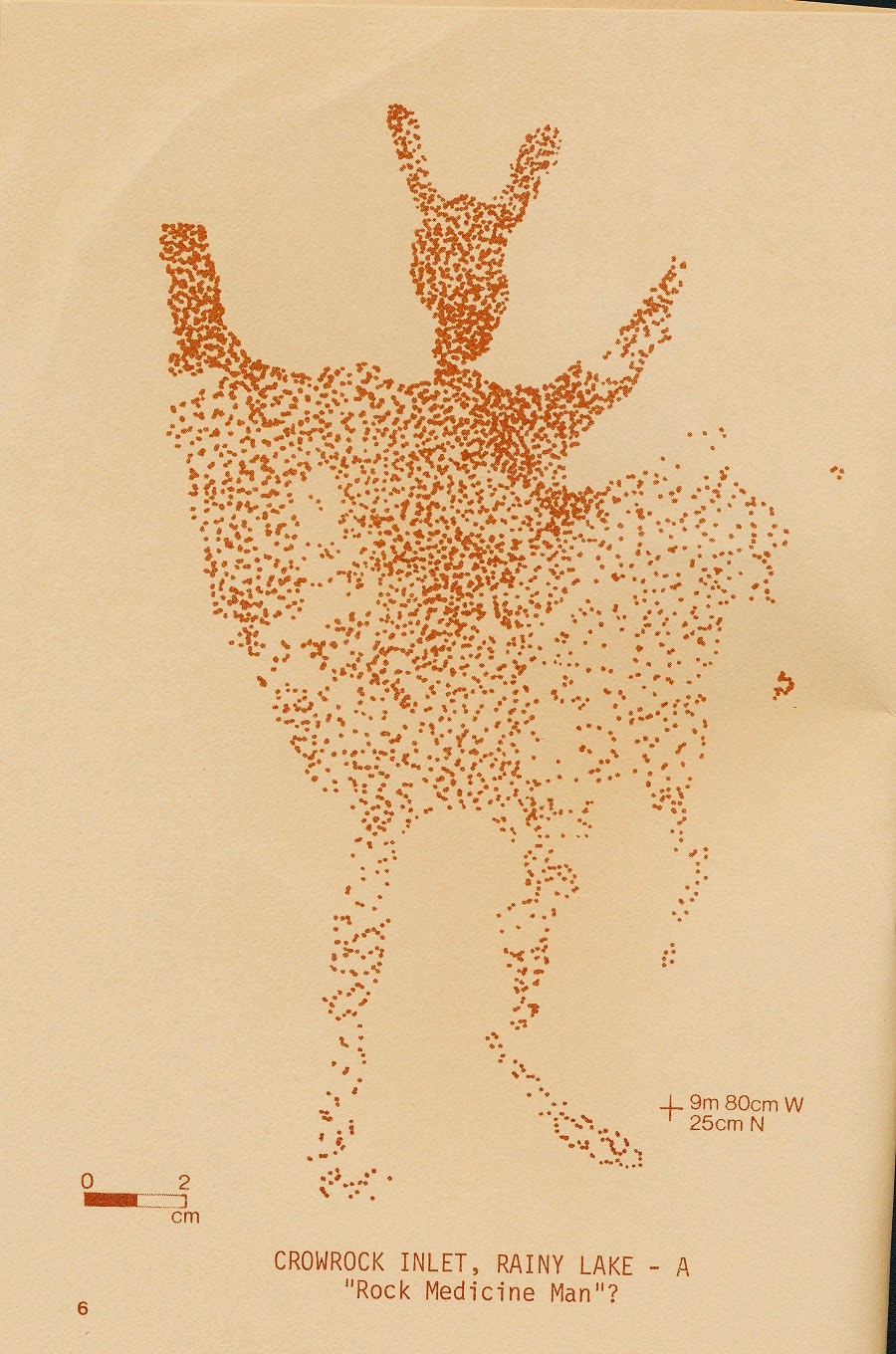
A woman of Oxford House Band was very sick.  The woman’s family asked an old man named Mistoos Muskego to come and cure her of her illness.  The old man tried again and again to cure the woman but nothing seemed to work.  Finally the old man said that there was only one hope left and that was to go and ask the men who lived in the rock if they could give him the powerful medicine needed to cure the woman.  The old man left in his canoe and paddled to where he knew they dwelt.  (This spot is today a granite rock face rising sharply upwards from the Semple River even as it was in Mistoos’ day.)  The old man was very powerful and used his power to enter the rock, into the home of the men who lived there.  The old man talked for a long time with the men who lived in the rock and asked for the medicine that would cure the woman, and in the end he was given the medicine that he requested.  The old man then left the rock and paddled back to the home of the woman who was ill.  The medicine of the men who lived in the rock was given to the woman who was ill.   This medicine cured the woman.  The old man said that all should remember it was the men who lived in the rocks who were powerful and could give medicine to a powerful old man.  The old man then made a paint and asked all the people to come with him to the mome of the men who lived in the rocks.  The old man and the people then paddled  their canoes up to the rock ledge by the water.  He told the assembled people how he had  received the medicine.  He then said that no one should forget the men who lived in the rock and that he would draw a painting of them. (He then drew a painting about two feet high, stick-figured with lines running from the head giving a “rabbit-eared” look.)  The people now would remember where the men who lived in the rock lived and what they looked  like, and all returned home.

Clint Wheeler, CRARA Newsletter (Manitoba Chapter) 1:4

Page 8

The man who told the researcher the story had heard it from his grandmother, and her grandmother had been present, as a little girl, at the painting.

The above story links the painting to Cree Medicine and similar paintings may be an element also of Ojibway Medicine. Researchers have noted distinct similarities between the painted figures and the forms on birch bark scrolls of the Ojibway Midewiwin, or Grand Medicine Society.

WHAT DO THEY MEAN?

Many of the figures are executed in such an abstract fashion that it is difficult to recognize them.  Some are distinguishable as bear, moose, bison, etc., but some are simply generalized animal or human figures.  The abstract and symbolic figures makes interpretation difficult without access to the original artists. Indeed, the artists may have preferred abstractions so that only they knew what the paintings meant.

We can see that on many paintings there are groups of figures probably telling a story.  The Algonkian concept of spatial organization is not a left-to-right progression as in writing but a generalized grouping of forms as in a picture.  The figures, if they were meant to be used in the same manner as those on the birch bark scrolls, were meant simply as memory aids for the shaman-artist to recall a story – historical or mythological or both – related to the area where the painting was done.  The above recollection from Oxford House describes such a situation.

It is likely that each site has not one but several meanings depending on the audience.  Ojibway writer Basil Johnston has pointed out that Ojibway stories are not to be interpreted literally but have four depths of meaning: enjoyment, moral teaching, philosophic, and metaphysical.  Readers draw their own  inferences according to their knowledge and abilities.  The same is likely true of the rock art sites.

Page 9

Some figures may be spirits – the upraised arms of the human figures denote the spiritual quality perhaps of Maymaygwayshi, or Rock Medicine Men, who live in the cliffs and are known to steal fish from nets and bother Indians canoeing by the site, but they also have positive qualities as the Oxford House story relates.

Page 10

The animal figures are probably not only the ephemeral catch of the hunt but also the ethereal spirits of the Species – the Spirit Bear, the Spirit Wolf, etc. , who allow the Indians to kill animals for food and who have prominent roles in the Midewiwin both as spirit guardians and guides but sometimes as threats, depending on their positive or negative roles.

HOW SHOULD THE SITES BE TREATED?

The Indian rock art sites are considered by many Cree and Ojibway to be sacred and offerings are still left for the spirits at many sites in the Northwestern Region. The pictographs and petroglyphs are also valuable archaeological records of past Indian Cultures and therefore, under The Ontario Heritage Act, 1974, it is illegal to deface a rock art site, under penalty of up to $5,000 and/or up to two years in jail.

The sites should be treated with care and respect. DO NOT TOUCH THE ROCK PAINTINGS. Human perspiration can break down the bond between rock and paint. Do not use an abrasive such as sand, in the rock carvings to get a clear outline. The sand will eventually wear away the rock and destroy the carving.

TIPS FOR PHOTOGRAPHY  (pre-digital)

1)      Use ASA 64 film for colour slides or prints.

2)      For pictographs, try for a slightly overcast day: one that is bright, but not sunny. Sun tends to produce a glare on the rock face and too much shade produces pictures that are too dark with unnatural purplish tints in the pigment.

3)      “Bracket” the f-stop setting on the camera. If your light metre calls for an f-stop of 8, take shots also at 5.6 and at 11 to make sure you get a good picture.

4)      For petroglyphs, visit the sites either early in the morning or late in the afternoon to get slanted sunlight on the rock slope that creates deep shadows in the figures and makes them visible.  Overhead sun blots out the figures. Page 11


Page 12

FOR MORE INFORMATION

The Canadian Rock Art Research Associates (CRARA), founded by the late Selwyn Dewdney, is a group of amateur researchers and professional archaeologists dedicated to the preservation of Canada’s Indian rock paintings and carvings and to the dissemination of information on the subject.

Department of Anthropology and Archaeology

University of Saskatchewan,

Saskatoon, Saskatchewan

S7N 0W0


The Regional Archaeologist’s Office, Northwestern Region, Historical  Planning and Research Branch, Ontario Ministry of Culture and Recreation, has recorded many of the rock art sites of the region

207 First Street South

Box 2880

Kenora, Ontario

P9N 3K8


FOR FURTHER READING

Dewdney, Selwyn, Indian Rock Paintings of the Great Lakes.  University of Toronto Press

Dewdney, Selwyn. Sacred Scrolls of the Southern Ojibway.  University of Toronto Press.

Studies in West Patricia Archaeology Nos. 1 and 2.  Edited by C.S. Paddy Reid. Toronto: Historical Planning and Research Branch, Ontario Ministry of Culture and Recreation. (Archaeology Research Report series.)


Page 34

HERITAGE CONSERVATION

Archaeological sites are fragile heritage resources containing society’s only source of information about most of its past.  Broken bits of pottery and arrowheads are more than interesting curios – they are important fragments  of scientific evidence.  Urban development, highway construction, and thoughtless artifact collectors are destroying this evidence at an alarming rate.


It is the responsibility of the Historical Planning and Research Branch, Ontario Ministry of Culture and Recreation, to identify and preserve archaeological and historical resources.  This aim can be achieved only with the help and support of all citizens of the Province. For further information please contact the Regional Archaeologist in your area.

Sunday, 31 August 2014

continuing INDIAN ROCK PAINTINGS 2

BLOODVEIN RIVER  (detail)
0  to 10 cm
JACKFISH LAKE NEAR RAINY LAKE

JACKFISH LAKE NEAR RAINY LAKE

CUTTLE LAKE LARGE SITE NEAR RAINY LAKE
0  TO 2CM
2m 3cm above rock ledge

CROWROCK INLET, RAINY LAKE
TOP   0  TO 2cm
10m  50cm W
38cm N
BOTTOM  0  to 2cm
10 m 50cm W
15 cm N

The booklet list Petroglyphs of Sunset Channel, Lake of the Woods and another site near Zigzag Island , Lake of the Woods. No way could I scan these photos as they were all reddish on reddish.

RED LAKE
0  to 15cm

BERENS RIVER
0  to 5cm

BERENS RIVER
0  to 5cm

PUKAMO ISLAND, RAINY LAKE
0  to 5cm
320 cm above water level June 24, 1979
CROWROCK INLET,  RAINY LAKE
Datum: 86cm above water level, August 21, 1979.
0 to 2cm

CROWROCK INLET, RAINY LAKE
0 to 2cm
8m  39cm W
46cm N
 
CUTTLE LAKE SMALL SITE NEAR RAINY LAKE
0  to 2cm
PICTURE ROCK ISLAND, LAKE OF THE WOODS
0  to 10cm
PICTURE ROCK ISLAND, LAKE OF THE WOODS
0  TO 10cm
PICTURE ROCK ISLAND, LAKE OF THE WOODS
0 to 10 cm

DEER LAKE

Saturday, 30 August 2014

INDIAN ROCK PAINTINGS 2

THE ARCHAEOLOGY OF NORTHWESTERN ONTARIO
2
INDIAN ROCK PAINTINS AND CARVINGS
MINISTRY OF CULTURE AND RECREACTION HISTORICAL PLANNING BRANCH
C. 1980
Hon. Reuben C. Baetz   Minister
Dr. Douglas Wright   Deputy Minister
ISBN 0-7743-5583-2


The Cuttle Lake Large Site Near Rainy Lake

Crowrock Inlet, Rainy Lake - A "Rock Medicine Man?"
 
Annie Island, Lake of the Woods

0 to 25cm
 
Pineneedle Lake
0  to 15 cm

Blindfold Lake
0  to 10 cm

Bloodvein River
0  to 50 cm
I will continue the rock art in the next post.

Sunday, 17 August 2014

LAW OF THE LAND, 1925


GOVERNING THE SUPERIOR GAME PRESERVE, DISTRICT OF THUNDER BAY


( Extract from the Ontario Gazette of Saturday, November 7th, 1925)

COPY OF AN ORDER- IN- COUNCIL, APPROVED BY THE HONOURABLE THE LIEUTENANT – GOVERNOR, DATED  THE 30TH DAY OF OCTOBER, A.D. 1925.

Upon the recommendation of the Honourable the Minister of Mines, the Committee of Council advise that, pursuant to the provisions of clause (g) of Section 8 of The Ontario Game and Fisheries Act, it shall be unlawful to hunt, take, pursue, kill, wound, destroy or have in possession any bird or animal, or be in possession of any firearm of any description on the territory described below, and such territory to be created as a Crown Game Preserve, and designated as “The Superior Game Preserve;” such lands being more particularly described as follows:

All the territory in the District of Thunder Bay situate and lying south of a point located at the mouth of the Black Sturgeon River where it enters Black Bay east of the Village of Hurkett, thence along the eastern bank of the river to the Canadian National Railway to a point on the Nipigon Bay known as Red Rock, thence easterly to the rock quarries located at the mouth of the Nipigon River south of the Village of Nipigon, thence following the shore line of the main land to a point due south of the westerly boundaries of the Village of Schreiber, together with the waters of Black Bay and all the islands therein.

The provisions of this Regulation shall not apply to any officer of the Department of Game and Fisheries who may be given a special permit to carry firearms and to kill predatory animals and vermin on the Preserve, or take animals for educational, scientific or propagation purposes; provided, however, that the District Warden may issue a permit to have firearms in possession and to take all water fowl, during the regular open season, on the waters of Lake Superior and bays thereof, within the territories of the above Preserve.

The Committee further advise that the Order-in-Council, dated the 21st day of October, 1924, governing the “Superior Game Preserve,” be revoked.

Certified,

(signed) C. F. Bulmer,

Clerk, Executive Council.

Saturday, 16 August 2014

SCHOOLS OF THE AREA

JELLICOE SCHOOL 1925
JELLICOE SCHOOL 1935

STURGEON RIVER GOLD MINE, SCHOOL
NEZAH  CNR 11 MILES
MISS HEBDEN, 1941

STURGEON RIVER GOLD MINE SCHOOL, 1941

COLDWELL SCHOOL, 1936
MISS POWELL, TEACHER


ALL PHOTOS BY E.C. EVERETT, NIPIGON

Friday, 15 August 2014

George Nicholson's LIFE IN THE NIPIGON DISTRICT


By: L.M. “Buzz” Lein

When Buzz wrote this sometime in the early 1980’s (likely 1983) , George Nicholson was alive, therefore the title:

GEORGE NICHOLSON – LIVING HISTORY

‘Someone once asked me how we found all these stories that we share with our readers. The answer is simply that we don’t – the stories find us.  As is the case with the one you are about to read.”

“If you recall, we wrote about a shipwreck on  Lake Nipigon in 1910.  This sparked a special interest in a Red Rock resident.  We were invited to communicate with him because he said that he knew quite a bit about those old boats that steamed up and down Lake Nipigon.”

“We did just that.  Not only did we meet an extremely nice gentleman but we added immensely to our Nipigon story.  You are reminded that we had no idea  who we were going to meet, and a vague idea of what we were going to talk about.”

“Meet George Nicholson of Red Rock.  This grey haired gentleman in his 88th year (as near as we can tell) is fluently bilingual.  He has spent his life in the Nipigon dIstrict;  has done everything he had to do  to survive and while he may have some regrets about some of the things that happened to him he is not bitter about the way life has treated him.  He has an excellent memory for bygone days and speaks about the past with an easy flow of language that would put many a university student to shame.”

“George Nicholson was born on the south end of Ignace Island at a place called by him “Burnt Harbour”.  We cannot find this spot on any of our maps. Since George’s birth was not recorded, he has only hearsay to go on when asked how old he is.  But backtracking in time from some things he told us, it was either 1895 or 1896.”

“While in Burnt Harbour, his mother died and his father presumably, decided tomove into Nipigon where there would be someone that could look after the baby better than he could.  But on the way in to Nipigon, the boat that was carrying them piled up on a rock and sank. No lives were lost but they had to row all the  back to Burnt Harbour to get some help.”

“Our guess is that Burnt Harbour was the headquarters for a group of commercial fishermen who abounded throughout this area about this point in time.  They arrived in Nipigon finally – at Red Rock as it was known in those days.  They disembarked at Nicholson’s Landing.  We think this is  the place where John Dampier  built his little cabin.  On the East bank opposite the Red Rock Post. But the Nicholson family were burnt out and had to move again.”

“ By this time George’s father was working on construction of the Revilllon Bros. post in Ombabika Bay at the north end of Lake Nipigon.  Taking a guess we would say this was about 1907 or 1908.  The Nicholson family then moved into this post and lived there while George’s father worked on the steamer Ombabika.”

“This boat was a steamboat and was fired with wood at the start – switched over to coal as the Nipigon Tramway came into service and could haul coal into South Bay. This Ombabika, by the way, was built at South Bay about 1906 from a kit that was made up and hauled into South Bay over winter roads.  This also was a Revillon  Boart.”

Revillon also built a motorized Scow, powered by steam. It was a big brute and had a shallow draught for getting heavy loads close to shore.  This one was the real workhorse of the Lake carrying hay, oats, horses, men and anything else that could be loaded on board.”

“It carried the material needed by the North Transcontinental to build their railroad across the top of Lake Nipigon.  Today it is part of the C.N.R. from Winnipeg to Montreal.”

“It was the Minewa that attracted George’s attention when he heard about the article we wrote on the 1910 shipwreck at Scherburn Island.  And we were wondering where the heck this Island was because we had never heard of it.”

By the way, in Ojibway, Minewa means “going back and forth.” Somewhat irreverently, we like the word “Yo-yo” better.”

“Anyway, the reason that Nicholson knew why the 1910 newspaper reported got the name of the boat wrong;  why the name of the Island was wrong;  why the location was incorrectly reported – was that George Nicholson  himself was on board the Minewa when the Captain piled it up on Flatlands Is..”

“This latter is north westerly from the mouth of the Sturgeon River about nine miles. It well deserves its name.  George, at the time was 14 or 15 years old and was sort of a roustabout on the scow. His father was also working on the craft at the same time.”

“Anyway, that Minewa was grossly overloaded with so much hay piled up in the front of the craft that visibility was much curtailed. It wouldn’t have mattered if that day had been calm and sunny – but it wasn’t.  It was snowing to beat hell the way it can do on Lake Nipigon and you couldn’t see 50 feet in any direction.”

“Now the Minewa had a shallow draught and was darn close to shore when they crunched on the bottom.  Probably sprang a small leak and since they couldn’t move, the scow just sat there and filled up. There were a couple of yawl boats and a whole crew of men on board so they scrambled off; un-loaded all the food they needed and just waited out the weather.”

“Sure enough as soon as the weather cleared – probably the next day – the Ombabika on her way north spotted the disabled craft and came to the rescue.  The Ombabika probably took most of the men back to South Bay, along with the Minewa Captain, Nicholson Sr. was left in charge.”

“By the time the Insurance investigation was complete – and by the way, that long ago reporter got the adjuster’s name right at least. George Rapsy. When all this was cleared up, the water transport was over for the year  and  George’s father took him to Ombabika Bay; ran in as far as the ice would let him and dumped  the young  fellow off and told him to hike home to the Revillon Post.  Obviously he made it all right.”

“George spent the winter of 1910-1911 freighting over the ice from South Bay to the Tramway terminus in Ombabika Bay. With freighting from South Bay to the Tramway terminus in Ombabika Bay complete;  the Nicholsons moved again, this time to South Bay where Nicholson Sr. became the Captain on another little steamer called  the “Pewabic” (iron) and moved freight from South Bay to MacDiarmid for the construction of the Canadian Northern.”

“George’s father worked for the Ontario Forestry Branch out of MacDiarmid for 36 years, mostly running the boat “Ogima” – (‘chief’ in Ojibway) - .  Abitibi had a boat by this name on Lake Nipigon, but it wasn’t this one – theirs was the Ogima II. It’s  at Oscar Styffe’s dock in Port Arthur.”

“George was now living at Sand Point which was the settlement  that preceded MacDiarmid. He worked for a while fishing on Lake Nipigon; worked for the railway as a section man and did whatever he had  to do to make a living.”

“ In those days there was no unemployment insurance and if you didn’t work, you didn’t get any money. Since work on the railway and fishing was seasonal employment a guy had to be nimble footed indeed to remain gainfully employed. Especially in and around Lake Nipigon.”

“We think that Nicholson freighted on the construction of the C.N.R. from MacDiarmid to Longlac but we have to talk to him about this. We were amused at one remark that George made about the time he was living and freighting out of South Bay and that was about the presence of a “whiskey” policeman there. He knew the guy’s name – it was Van Norman. Ring a bell? Van Norman Street in Port Arthur? His job was to check all northbound people for the possession of alcohol.  Van Norman must have confiscated dozens of bottles.  We often wonder where all those old whiskey bottles around Lake Nipigon came from. – Van Norman sure as heck didn’t get them all.”

“We also note A. M. Lower in his short description of going north on Lake Nipigon in 1909 mentions provincial policemen at South Bay checking one and all for the presence of liquor.”